'%3e%3cg%20id='Objet_dynamique_vectoriel'%20data-name='Objet%20dynamique%20vectoriel'%3e%3cg%20id='Objet_dynamique_vectoriel-2'%20data-name='Objet%20dynamique%20vectoriel-2'%3e%3cpath%20id='Tracé_76'%20data-name='Tracé%2076'%20d='M-434.579,776.023a17.389,17.389,0,0,1-4.169,6.166,19.974,19.974,0,0,1-6.538,4.078,23.18,23.18,0,0,1-8.535,1.5h-14.714v25.368h-9.8V748.579h24.513a23.181,23.181,0,0,1,8.535,1.5,19.94,19.94,0,0,1,6.538,4.082,17.322,17.322,0,0,1,4.169,6.208,21.784,21.784,0,0,1,0,15.64Zm-11.482-15.845a11.977,11.977,0,0,0-8.306-2.81h-14.177v21.49h14.177a12.1,12.1,0,0,0,8.306-2.764,10.012,10.012,0,0,0,3.131-7.923A10.163,10.163,0,0,0-446.061,760.178Z'%20fill='%23fbfdfe'%3e%3c/path%3e%3cpath%20id='Tracé_77'%20data-name='Tracé%2077'%20d='M-373.837,813.132l-29.87-45.423v45.423h-9.807V748.579h8.989l29.871,45.335V748.579h9.807v64.553Z'%20fill='%23fbfdfe'%3e%3c/path%3e%3cpath%20id='Tracé_78'%20data-name='Tracé%2078'%20d='M-340.247,813.132V748.579h41.312v8.793H-330.44v18.859h26.873v8.7H-330.44v19.4h31.505v8.8Z'%20fill='%23fbfdfe'%3e%3c/path%3e%3cpath%20id='Tracé_80'%20data-name='Tracé%2080'%20d='M-527.707,914.067V845.061h10.482v59.6h33.286v9.4Z'%20fill='%23fbfdfe'%3e%3c/path%3e%3cpath%20id='Tracé_81'%20data-name='Tracé%2081'%20d='M-424.973,914.067l-4.755-13.86h-27.256l-4.755,13.86h-11.142l25.3-69.006h8.423l25.349,69.006Zm-18.147-53.3-10.771,30.621h21.253Z'%20fill='%23fbfdfe'%3e%3c/path%3e%3cpath%20id='Tracé_82'%20data-name='Tracé%2082'%20d='M-382.929,914.067h-8.151l-22.729-69h10.87l15.914,50.2,15.95-50.2h11.061Z'%20fill='%23fbfdfe'%3e%3c/path%3e%3cpath%20id='Tracé_83'%20data-name='Tracé%2083'%20d='M-312.092,914.067l-4.755-13.86h-27.27l-4.755,13.86h-11.142l25.327-69h8.441l25.313,69Zm-18.147-53.3-10.772,30.621h21.249Z'%20fill='%23fbfdfe'%3e%3c/path%3e%3cpath%20id='Tracé_84'%20data-name='Tracé%2084'%20d='M-292.55,914.067v-9.4h33.287v-59.6h10.477v69.006Z'%20fill='%23fbfdfe'%3e%3c/path%3e%3cpath%20id='Tracé_84-2'%20data-name='Tracé%2084'%20d='M-483.941,636.8v9.4h-33.287v59.6h-10.477V636.8Z'%20fill='%23fbfdfe'%3e%3c/path%3e%3cpath%20id='Tracé_84-3'%20data-name='Tracé%2084'%20d='M-248.786,636.8V705.8h-10.477V646.2H-292.55v-9.4Z'%20fill='%23fbfdfe'%3e%3c/path%3e%3cg%20id='Groupe_275'%20data-name='Groupe%20275'%3e%3cpath%20id='Tracé_631'%20data-name='Tracé%20631'%20d='M-522.722,748.579h-3.938v15.3l.215-.61,9.807,28.653H-526.66v8.251h12.744l4.449,12.963h10.445Z'%20fill='%23fbfdfe'%3e%3c/path%3e%3c/g%3e%3cg%20id='Groupe_276'%20data-name='Groupe%20276'%3e%3cpath%20id='Tracé_632'%20data-name='Tracé%20632'%20d='M-267.976,804.334v-19.4h19.19v-8.7h-19.19V757.372h19.19v-8.794h-29v64.553h29v-8.8Z'%20fill='%23fbfdfe'%3e%3c/path%3e%3c/g%3e%3c/g%3e%3c/g%3e%3cg%20id='Groupe_277'%20data-name='Groupe%20277'%3e%3cpath%20id='Tracé_633'%20data-name='Tracé%20633'%20d='M-308.416,733.851l-12.177,11.217h-6.9l8.914-11.217Z'%20fill='%23fbfdfe'%3e%3c/path%3e%3c/g%3e%3c/g%3e%3c/svg%3e)
Dental sleep medicine clinic — Laval
Breathe better at night, get your energy back during the day
Snoring, persistent fatigue, a CPAP that’s hard to tolerate? Our team assesses your situation and explains, with no pressure, the options available — including the custom mandibular advancement device.
Educational information. A diagnosis of sleep apnea must be made by a physician, following a sleep evaluation.
Quick answer
What is Apnée Laval?
Apnée Laval is a dental sleep medicine clinic in Laval, Quebec. The team assesses snoring and sleep-related breathing concerns and makes custom mandibular advancement devices, working with the patient’s physician.
- Services are offered in French and English.
- A sleep apnea diagnosis is made by a physician, after a sleep evaluation.
- The appliance is made from impressions of your mouth and adjusted during follow-up.
Do you recognize yourself?
Does this sound like you?
These signs are not a diagnosis, but they often warrant a discussion with a professional.
Loud, regular snoring
Snoring that disturbs those around you can be a sign of a sleep-related breathing disorder.
Observed breathing pauses
Your partner notices pauses in breathing or loud gasps for air during the night.
Fatigue upon waking
You sleep enough hours, but wake up without feeling rested.
Daytime sleepiness
You struggle to stay awake at work, in meetings or while driving.
Morning headaches
Headaches upon waking or a dry mouth happen regularly.
Difficulty with CPAP
You have a machine, but can’t manage to use it through the whole night.
Understanding
What happens in your airway
A simple illustration to visualize the role of jaw position during sleep.
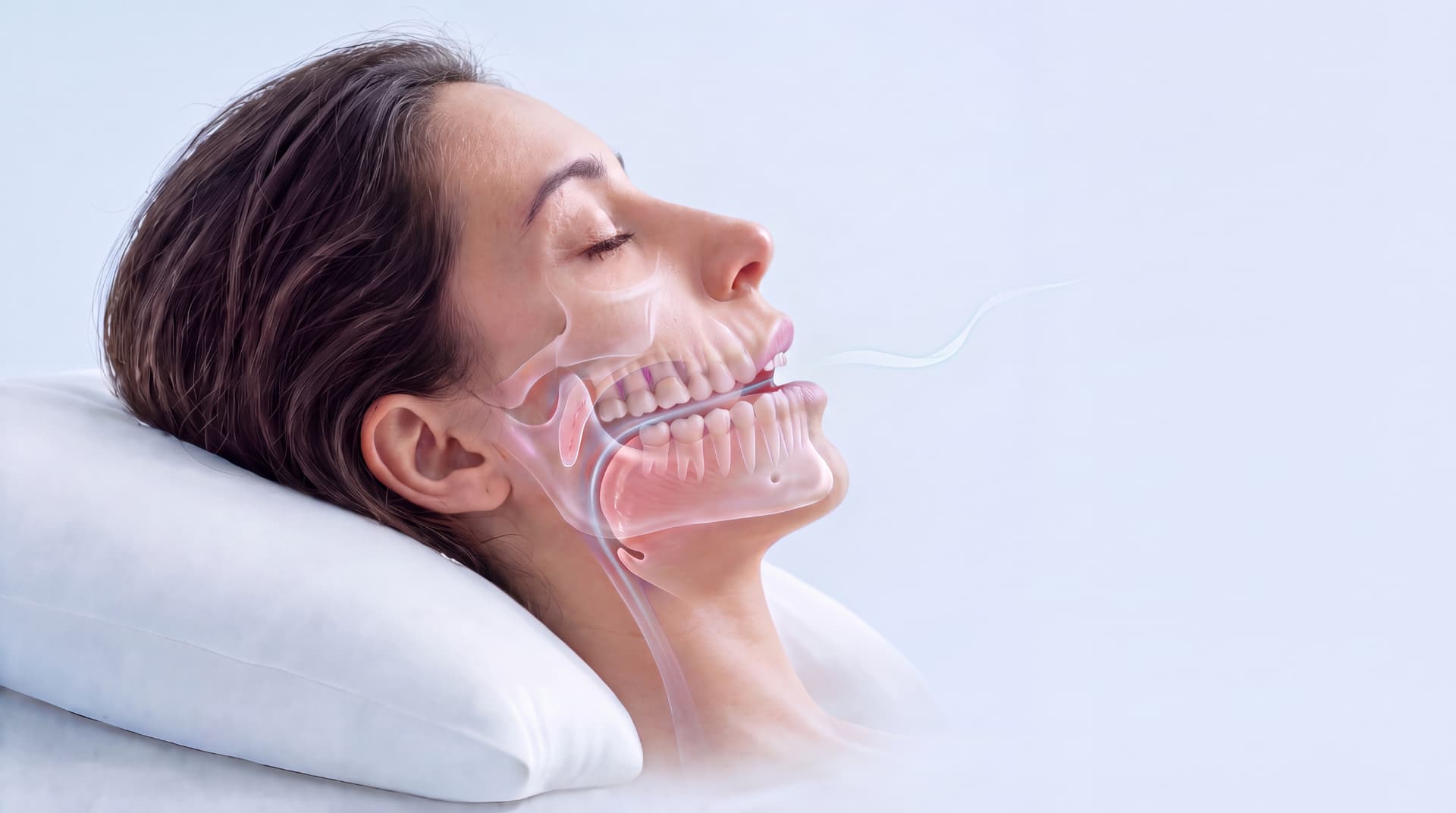
Without an appliancethe jaw falls back
During sleep, muscles relax and the jaw slides backward. The airway narrows, which can cause snoring and pauses in breathing.
Without an appliance, the jaw falls back
During sleep, muscles relax and the jaw slides backward. The airway narrows, which can cause snoring and pauses in breathing.
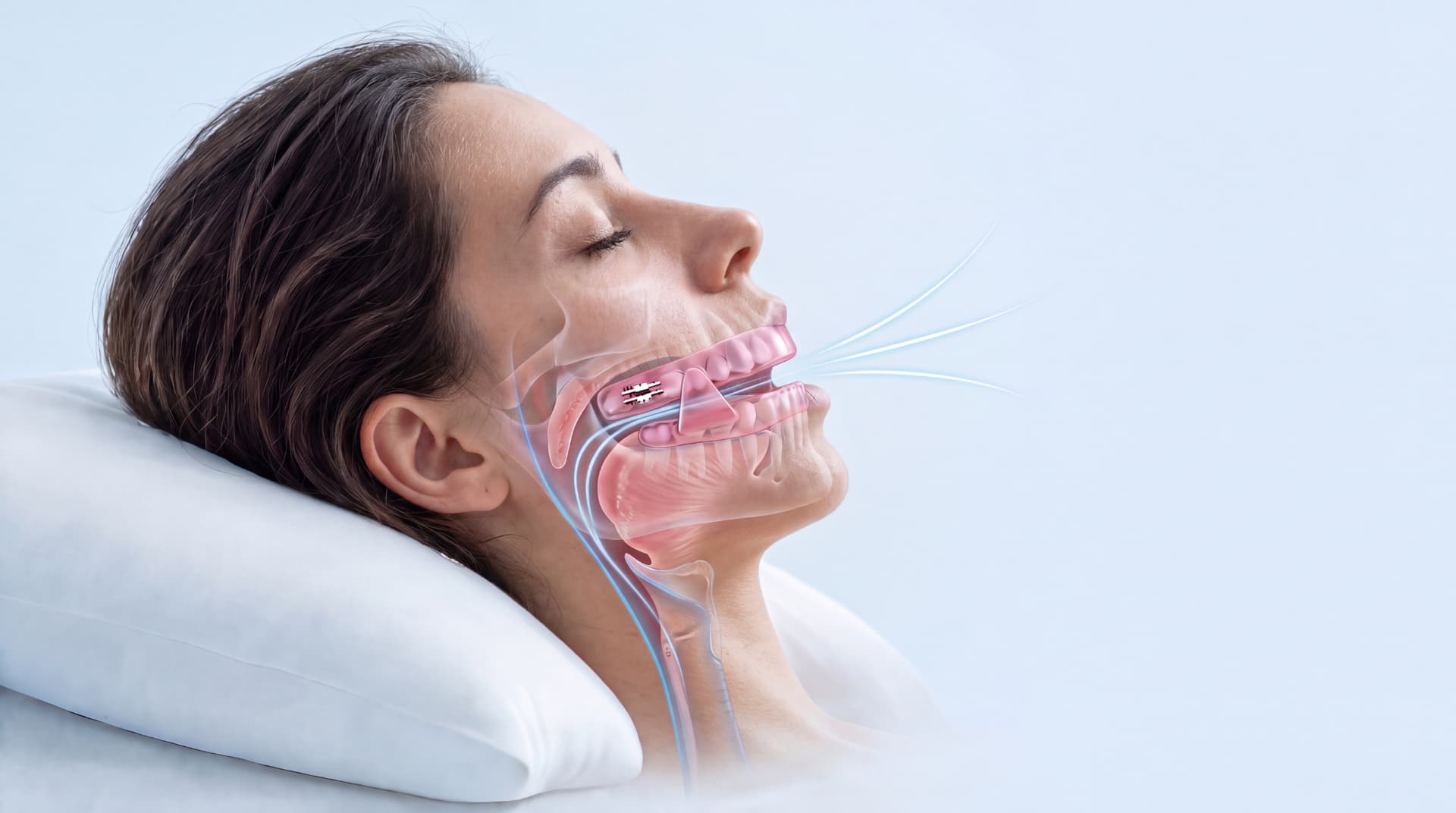
With the appliance, the airway stays open
The custom appliance gently holds the jaw forward. The airway stays clear and air flows more freely through the night.
Custom-made, discreet and portable
Made from impressions of your mouth, the appliance gently holds the jaw forward during sleep to keep the airway open.
No electricity, no mask and no noise: it fits in a case the size of your fist.
The journey
What working with us looks like
Every step is explained ahead of time. You set the pace, in collaboration with your physician.
-
1. First conversation
We discuss your symptoms, your history and your goals. No obligation, no commitment.
-
2. Sleep assessment
If a sleep test is needed, we explain the options and the referral process.
-
3. Dental examination
We check the health of your teeth, gums and jaw joint to assess whether an oral appliance is suitable.
-
4. Impressions and fabrication
Precise impressions are taken and sent to the lab to make your custom appliance.
-
5. Fitting and adjustments
We fit the appliance, explain how to care for it, and make the adjustments needed over the following weeks.
-
6. Follow-up
We monitor your comfort and your response to treatment, in collaboration with your physician.
Compare
CPAP and mandibular advancement device
Two different approaches, each with its own realities. The right choice depends on your diagnosis and your physician.
| Aspect | CPAP | Mandibular advancement device |
|---|---|---|
| What it involves | A machine that delivers pressurized air through a mask during the night. | A custom oral appliance that holds the lower jaw slightly forward. |
| Generally considered for | Obstructive sleep apnea, including more severe forms. | Often considered for mild to moderate apnea, or when CPAP is not well tolerated. |
| Comfort and habits | Requires a mask, tubing and a power source; an adjustment period is common. | Worn in the mouth, with no noise or electricity; an adjustment period is also needed. |
| Travel | A device to carry, power supply required. | Compact and easy to travel with. |
| Maintenance | Regular cleaning of the mask, tubing and filters. | Daily cleaning and periodic check-ups at the clinic. |
| Who decides | Prescribed and monitored by a physician, following a sleep assessment. | Recommended after a medical and dental evaluation; provided by a trained dentist. |
What it involves
CPAP
A machine that delivers pressurized air through a mask during the night.
Oral appliance
A custom oral appliance that holds the lower jaw slightly forward.
Generally considered for
CPAP
Obstructive sleep apnea, including more severe forms.
Oral appliance
Often considered for mild to moderate apnea, or when CPAP is not well tolerated.
Comfort and habits
CPAP
Requires a mask, tubing and a power source; an adjustment period is common.
Oral appliance
Worn in the mouth, with no noise or electricity; an adjustment period is also needed.
Travel
CPAP
A device to carry, power supply required.
Oral appliance
Compact and easy to travel with.
Maintenance
CPAP
Regular cleaning of the mask, tubing and filters.
Oral appliance
Daily cleaning and periodic check-ups at the clinic.
Who decides
CPAP
Prescribed and monitored by a physician, following a sleep assessment.
Oral appliance
Recommended after a medical and dental evaluation; provided by a trained dentist.
This table is informational and does not replace professional advice. The choice of treatment belongs to your physician and your care team, based on your diagnosis and health status. We do not replace a CPAP prescribed without your physician’s agreement.
Self-assessment
Could an oral appliance be part of the discussion?
Check what applies to your situation. Nothing is saved.
0 statement(s) selected
Frequently asked questions
Your questions, our answers
First step
Let’s talk about your sleep
Answer a few quick questions. A member of our team will call you back to explain the possible next steps.
- • No obligation or commitment
- • Clear explanations, no jargon
- • Collaboration with your treating physician